After Cell Division the Parent Cell Divides Againno Longer Exists
Where Do Cells Come From?
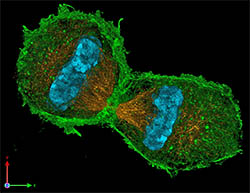
3D image of a mouse cell in the final stages of jail cell sectionalisation (telophase). (Image by Lothar Schermelleh)
Sometimes you accidentally seize with teeth your lip or skin your articulatio genus, but in a matter of days the wound heals. Is it magic? Or, is at that place some other explanation?
Every day, every hour, every 2nd i of the well-nigh of import events in life is going on in your body—cells are dividing. When cells split up, they brand new cells. A single prison cell divides to make 2 cells and these two cells then carve up to make four cells, then on. Nosotros telephone call this process "cell division" and "jail cell reproduction," because new cells are formed when former cells divide. The ability of cells to carve up is unique for living organisms.
Why Do Cells Divide?
Cells carve up for many reasons. For case, when y'all skin your knee, cells divide to replace old, dead, or damaged cells. Cells also carve up so living things tin can grow. When organisms abound, it isn't because cells are getting larger. Organisms abound because cells are dividing to produce more and more cells. In human bodies, nearly ii trillion cells carve up every day.
Watch cells divide in this time lapse video of an animal prison cell (top) and an Eastward. coli bacteria prison cell (bottom). The video compresses 30 hours of mitotic cell sectionalization into a few seconds. (Video by the National Institute of Genetics)
How Many Cells Are in Your Body?
You lot and I began as a single cell, or what you would call an egg. By the time y'all are an adult, you lot will have trillions of cells. That number depends on the size of the person, but biologists put that number around 37 trillion cells. Yeah, that is trillion with a "T."
How Do Cells Know When to Split up?
In prison cell partition, the cell that is dividing is called the "parent" cell. The parent cell divides into two "daughter" cells. The procedure then repeats in what is called the cell wheel.
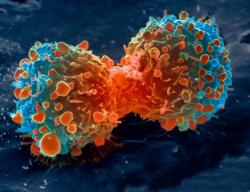
Jail cell division of cancerous lung cell (Paradigm from NIH)
Cells regulate their division by communicating with each other using chemical signals from special proteins chosen cyclins. These signals act similar switches to tell cells when to commencement dividing and later on when to finish dividing. Information technology is of import for cells to split and so y'all can grow and and so your cuts heal. It is too of import for cells to stop dividing at the right fourth dimension. If a cell can not finish dividing when information technology is supposed to finish, this tin can lead to a disease called cancer.
Some cells, like skin cells, are constantly dividing. We demand to continuously brand new skin cells to replace the peel cells we lose. Did you know nosotros lose 30,000 to 40,000 dead skin cells every minute? That means we lose around fifty million cells every day. This is a lot of peel cells to replace, making cell sectionalisation in skin cells is so important. Other cells, like nervus and brain cells, dissever much less ofttimes.
How Cells Split up
Depending on the blazon of prison cell, there are two ways cells carve up—mitosis and meiosis. Each of these methods of prison cell sectionalization has special characteristics. One of the cardinal differences in mitosis is a single cell divides into 2 cells that are replicas of each other and have the same number of chromosomes. This blazon of cell segmentation is adept for bones growth, repair, and maintenance. In meiosis a cell divides into four cells that have half the number of chromosomes. Reducing the number of chromosomes by half is important for sexual reproduction and provides for genetic diverseness.
Mitosis Cell Sectionalization
Mitosis is how somatic—or non-reproductive cells—separate. Somatic cells brand up most of your body'south tissues and organs, including skin, muscles, lungs, gut, and hair cells. Reproductive cells (like eggs) are not somatic cells.
In mitosis, the important thing to call back is that the daughter cells each have the same chromosomes and DNA equally the parent cell. The daughter cells from mitosis are called diploid cells. Diploid cells accept ii consummate sets of chromosomes. Since the daughter cells accept exact copies of their parent cell's DNA, no genetic diversity is created through mitosis in normal good for you cells.
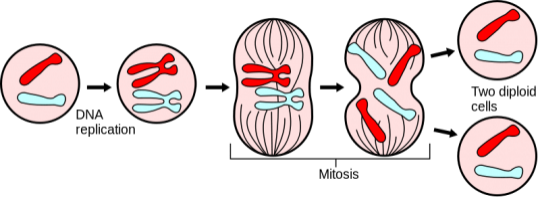
Mitosis jail cell division creates two genetically identical daughter diploid cells. The major steps of mitosis are shown hither. (Image by Mysid from Science Primer and National Center for Biotechnology Information)
The Mitosis Jail cell Cycle
Before a cell starts dividing, information technology is in the "Interphase." It seems that cells must be constantly dividing (think at that place are 2 trillion jail cell divisions in your body every mean solar day), merely each cell actually spends most of its time in the interphase. Interphase is the flow when a cell is getting ready to split and start the cell cycle. During this time, cells are gathering nutrients and free energy. The parent cell is also making a copy of its DNA to share equally between the 2 girl cells.
The mitosis segmentation procedure has several steps or phases of the cell cycle—interphase, prophase, prometaphase, metaphase, anaphase, telophase, and cytokinesis—to successfully brand the new diploid cells.
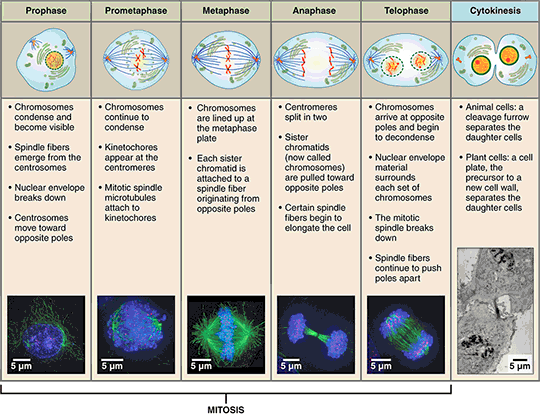
The mitosis jail cell bike includes several phases that event in two new diploid daughter cells. Each phase is highlighted here and shown by light microscopy with fluorescence. Click on the prototype to learn more virtually each phase. (Epitome from OpenStax College with modified work by Mariana Ruiz Villareal, Roy van Heesheen, and the Wadsworth Center.)
When a cell divides during mitosis, some organelles are divided betwixt the 2 daughter cells. For example, mitochondria are capable of growing and dividing during the interphase, and then the girl cells each take enough mitochondria. The Golgi appliance, however, breaks downwards before mitosis and reassembles in each of the new daughter cells. Many of the specifics nigh what happens to organelles before, during and subsequently prison cell partition are currently being researched. (You can read more near cell parts and organelles by clicking hither.)
Meiosis Cell Division
Meiosis is the other main way cells divide. Meiosis is cell division that creates sex cells, like female egg cells or male sperm cells. What is important to remember about meiosis? In meiosis, each new cell contains a unique gear up of genetic information. After meiosis, the sperm and egg cells tin join to create a new organism.
Meiosis is why we take genetic multifariousness in all sexually reproducing organisms. During meiosis, a pocket-size portion of each chromosome breaks off and reattaches to some other chromosome. This process is called "crossing over" or "genetic recombination." Genetic recombination is the reason total siblings fabricated from egg and sperm cells from the same 2 parents tin can look very different from one another.
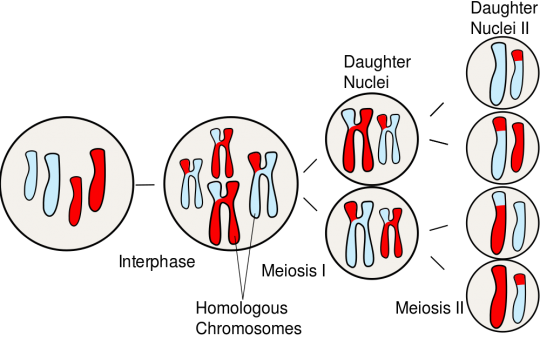
The meiosis cell bike has two main stages of sectionalization -- Meiosis I and Meiosis Two. The end upshot of meiosis is four haploid daughter cells that each contain different genetic data from each other and the parent prison cell. Click for more item. (Image from Science Primer from the National Center for Biotechnology Information.)
The Meiosis Cell Cycle
Meiosis has 2 cycles of jail cell division, conveniently called Meiosis I and Meiosis II. Meiosis I halves the number of chromosomes and is also when crossing over happens. Meiosis II halves the amount of genetic data in each chromosome of each prison cell. The end consequence is four girl cells chosen haploid cells. Haploid cells only take one set of chromosomes - one-half the number of chromosomes every bit the parent cell.
Before meiosis I starts, the cell goes through interphase. Simply like in mitosis, the parent cell uses this fourth dimension to prepare for cell division by gathering nutrients and energy and making a copy of its DNA. During the next stages of meiosis, this Dna will exist switched around during genetic recombination and then divided between 4 haploid cells.
So remember, Mitosis is what helps us grow and Meiosis is why we are all unique!
References:
Bianconi E, Piovesan A, Facchin F, Beraudi A, Casadei R, Frabetti F, Vitale L, Pelleri MC, Tassani South, Piva F, Perez-Amodio South, Strippoli P, Canaider South. Ann. An estimation of the number of cells in the human body. Retrieved March xiv, 2014 from https://www.ncbi.nlm.nih.gov/pubmed/23829164.
Original beast cell and E. Coli cell video from National Institute of Genetics via Wikimedia. https://commons.wikimedia.org/wiki/File:Movie_4._Cell_division.ogv
nichollsingre1964.blogspot.com
Source: https://askabiologist.asu.edu/cell-division
0 Response to "After Cell Division the Parent Cell Divides Againno Longer Exists"
Post a Comment